Harmful Algal Bloom Predictions: An Introduction
CIROH has supported the cyanobacterial harmful algal bloom (cyanoHABs) forecasting research team at the University of Vermont (PI Asim Zia). Dr. Zia’s team has over 10 years of experience in the prediction of cyanoHABs using ground-based observational data products and meteorological and hydrological forecast products such as the National Water Model. This team has begun to integrate satellite data products into their cyanoHABs forecasting workflows. In addition, Dr. Zia and UVM’s Dr. Patrick Clemins led the Northeast Evaluation Testbed for Water Resource Applications (NETWA; https://uvm.edu/water/netwa), a CIROH-funded project. NETWA has created
(1) data acquisition tools to help researchers access forecast and observational data products relevant to water resources prediction,
(2) computational workflows for forecasting that can utilize high-performance computing to simulate large numbers of scenarios in parallel,
(3) experimental protocol templates, and
(4) a community of practice for the use of advanced research computing and data techniques to further water resource prediction research.
Water Body Data Resources
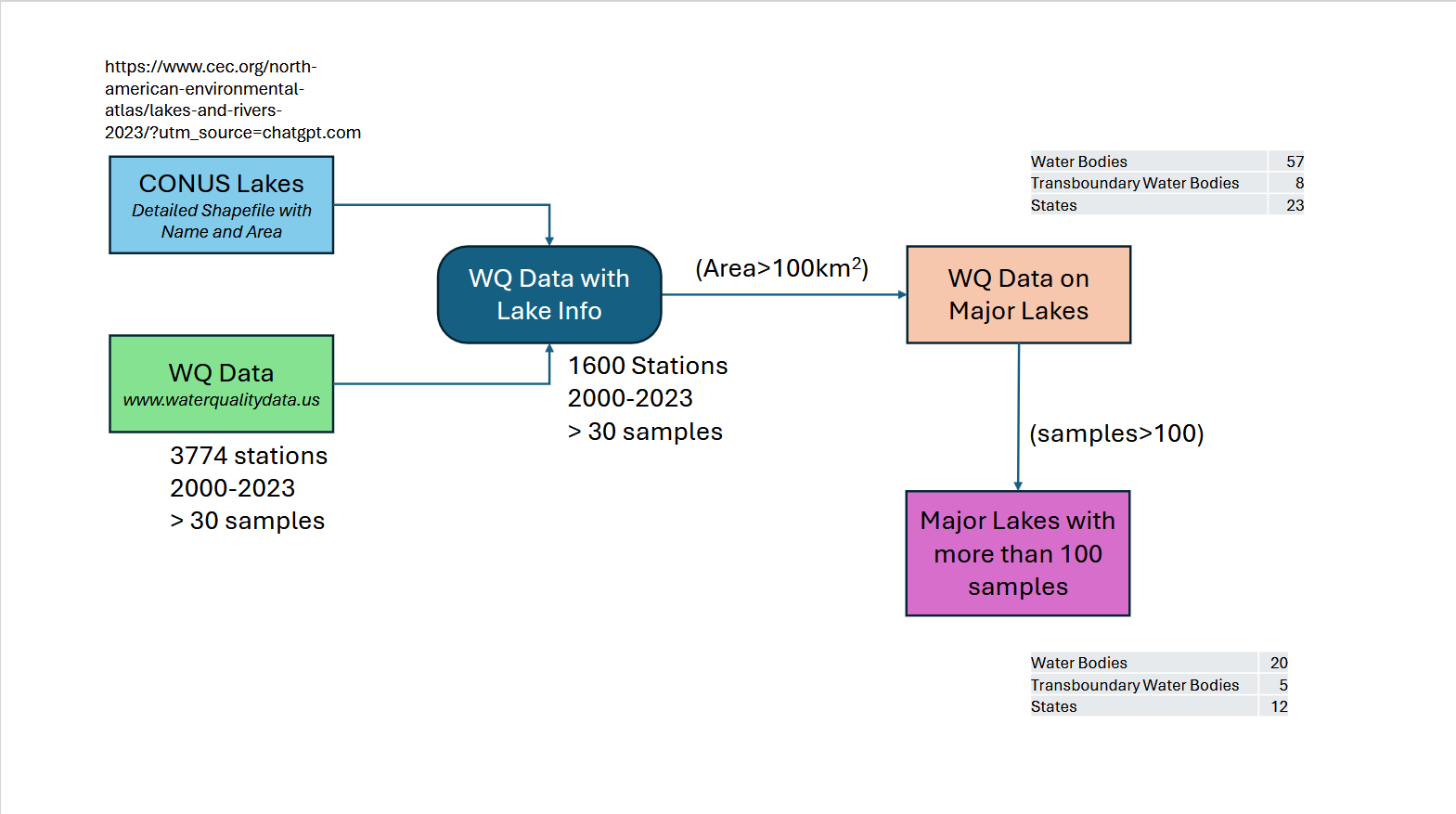
The Water Body Data Filtering workflow begins by integrating two primary datasets:
(i) lake boundaries obtained from the North American Environmental Atlas: Lakes and Rivers dataset, Version 4.0, developed by the Commission for Environmental Cooperation (CEC, 2023),
(ii) in situ water-quality observations locations retrieved from the Water Quality Portal (waterqualitydata.us) for the period 2000–2023.
The water-quality dataset was first filtered to retain only monitoring stations with at least 30 measurements during the study period, resulting in a dataset of 3,477 stations.
A spatial join was then performed to assign each water-quality monitoring station to the lake polygon in which it was located.
Following the spatial join, approximately 1,600 monitoring stations were found to be located within mapped lake polygons.
The resulting dataset was subsequently filtered to retain only major lakes with a surface area greater than 100 km², yielding water-quality observations for 57 major lakes, including 8 transboundary ones.
Finally, to ensure adequate temporal coverage and statistical robustness for subsequent analyses, only lakes with more than 100 water-quality samples over the study period were retained, resulting in a final dataset of 20 major lakes, including 5 transboundary ones.
Water Bodies Data Filtered Spreadsheet
Download Water Body Filtered Data CSV File