2 posts tagged with "Streamflow"

View All Tags

Continental-Scale Streamflow Simulation Using Kriging in the NGIAB-NRDS NextGen Ecosystem


· 5 min read
Suma Battula
Department of Geological SciencesThe University of Alabama
Kunal Sarna
Department of Computer ScienceThe University of Alabama
Sonali Vyas
Department of Computer ScienceThe University of Alabama
Harsha Vemula
DevOps EngineerAlabama Water Institute
Arpita Patel
Assistant Director, IT and DevOpsAlabama Water Institute
Jonathan Frame
Assistant Professor, Department of Geological SciencesAlabama Water Institute, The University of Alabama

Hourly streamflow kriging is now operational within the NextGen Research Data Stream, delivering spatially complete estimates for all NextGen v2.2 hydrofabric catchments. This observation-based approach supports streamflow analysis, NWM calibration, forecasting, and data assimilation for ungauged basins.

Kriging-Based Streamflow Estimation

Process-based hydrologic models are subject to structural and forcing uncertainties throughout the modeling domain, yet these can only be evaluated where USGS gauge observations exist. There is a clear need for a data-driven, observation-based framework that provides spatially complete streamflow estimates with well-characterized uncertainty, independent of model structure. Recent results from the CIROH project "Developing and Benchmarking Data Assimilation Methods on a Standardized Testbed" suggest that a simple Kriging interpolation between USGS gauged locations is both scalable and accurate for producing such spatially complete streamflow fields. As a pure data-driven method, this interpolation cannot be used directly for forecasting, but it serves as a valuable "pseudo-observation" for streamflow analysis and historical reconstruction.


Focusing on Streamflow Data: New Software for Camera-Based Hydrologic Modeling

· 5 min read
Sajan Neupane
Graduate Research AssistantUtah State University
Razin Bin Issa
Graduate Research AssistantUtah State University
Safran Khan
Graduate Research AssistantUtah State University
Sierra Young
Assistant ProfessorUtah State University
Jeffery S. Horsburgh
ProfessorUtah State University

Reliable and high-resolution streamflow data are essential for hydrologic research, flood forecasting, and water resource management. Streamflow gages provide necessary measurements but can be difficult and expensive to build and operate. Camera-based monitoring offers a promising, non-contact alternative to or augmentation of traditional streamflow gages. However, broad use of camera-based streamflow monitoring has been limited by operational challenges including how to collect, store, manage, and process the large volume of image and video data produced by monitoring cameras.

With help from Arpita Patel and the CIROH Cyberinfrastructure and DevOps Team, who assisted our team with access to Amazon Web Services and the Google Cloud Platform, we developed and tested new cyberinfrastructure that advances camera-based hydrologic monitoring.

Traditional dataloggers used in hydrologic monitoring focus on interfacing with conventional sensors (e.g., pressure transducers, float gages, etc.) and lack some capabilities required for camera-based monitoring. Low-cost field computers like the Raspberry Pi provide a capable alternative, but lack out-of-the-box software required to support high-resolution image and video capture, management of the large volume of data that accumulates, data processing, and cloud uploading processes. Because of this, we had to build the functionality required to combine low-cost field computers with cloud computing services to produce an operational, real-time, cloud-integrated, camera-based streamflow monitoring system.

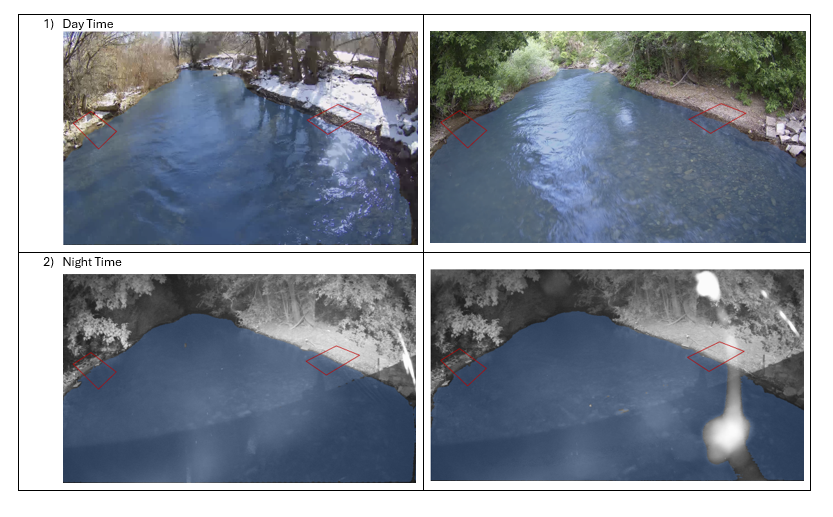
Segmented images by the Hydrocamcompute software
Figure 1. Segmented images showing pixels identified as water by the HydrocamCompute software. Quantifying water pixels within the rectangular areas of interest provide an estimate of stream stage and related discharge.