5 posts tagged with "Alabama Water Institute"

View All Tags

Hourly Differentiable Modeling Arrives in the NGIAB-NRDS NextGen Ecosystem

· 9 min read
Leo Lonzarich
Graduate Researcher
Quinn Lee
Programmer Analyst
Josh Cunningham
Software Engineer
Benjamin Lee
Development Operations Engineer
Arpita Patel
Assistant Director of DevOps and IT

In October 2025, Penn State's Multi-scale Hydrology, Processes and Intelligence group (MHPI), led by Dr. Chaopeng Shen, and the Alabama Water Institute (AWI), led by Steve Burian and Arpita Patel, achieved a milestone R2O effort: the preliminary integration of δHBV 2.0 [4] -- a daily-scale, high-resolution, distributed differentiable model -- into a NextGen ecosystem. This resulted in the first adoption of a differentiable model into NextGen In A Box (NGIAB) [2] and provided an opportunity for CIROH researchers to fine-tune the δHBV 2.0 architecture for NextGen operation.

Having proven viability for daily timescale predictions on high-resolution river networks [4], MHPI researchers recently adapted δHBV 2.0 into a multi-timescale architecture designed to parameterize HBV and simulate streamflow at hourly intervals, at scale, across the NextGen HydroFabric. This new model, δHBV 2.0 MTS (Multi-TimeScale) [5], is a fusion of a daily and hourly δHBV 2.0 model designed to efficiently handle ML training with high geospatial and temporal complexity. (See MTS Architecture for more details about this construction.)

With δHBV 2.0 MTS maintaining similar forecasting skill compared to its daily-scale counterpart [5], Penn State and AWI were once again reunited in a joint effort to embed hourly scale differentiable modeling within AWI's operational ecosystem as a demonstration of model viability and to facilitate open access to its runtime.

Differentiable Models

δHBV 2.0 and δHBV 2.0 MTS differentiable model constructions are briefly outlined here to contextualize the development efforts. For further detail, see each model's respective citation. At their core, differentiable models embed traditional process-based equations (here, the HBV rainfall-runoff model) inside a machine learning training loop. Because these models are designed to be differentiable (e.g., in PyTorch), gradients flow end-to-end from the loss function back through the physical equations and into the neural networks that supply their parameters. This lets the model learn optimal parameterizations directly from observed data while still obeying mass-balance and storage constraints encoded in HBV -- combining interpretability and physical consistency of process-based hydrology with the flexibility of deep learning.


Moving Hydrologic Prediction Forward — A software integration meeting at the Alabama Water Institute

· 10 min read
Martyn Clark
Professor of Hydrology at University of Calgary
James Halgren
Assistant Director of Science
Matthew Denno
Senior Engineering Applications Developer at RTI International
Arpita Patel
Assistant Director of DevOps and IT
Josh Cunningham
Software Engineer
Quinn Lee
Programmer Analyst
Sam Lamont
Environmental Applications Developer at RTI International
Darri Eythorsson
Postdoctoral Researcher at University of Calgary
Cyril Thebault
Postdoctoral Associate at University of Calgary
Sifan A. Koriche
Research [Hydrologic] Scientist
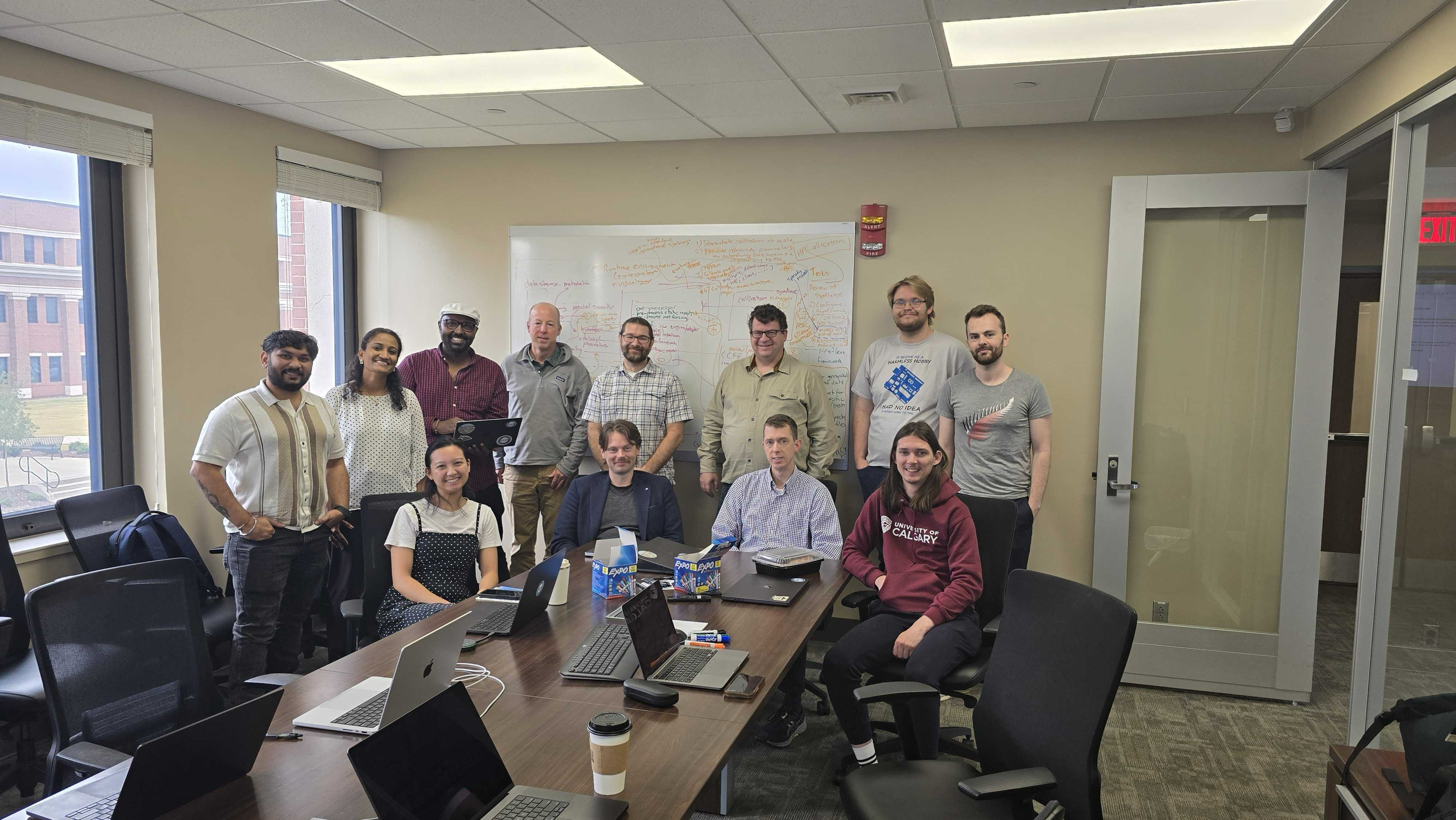
Group photo from the software integration meeting at the Alabama Water Institute

Last week, at the invitation and expert coordination of James Halgren, teams from RTI International (Sam Lamont and Matt Denno) and the University of Calgary (Darri Eythorsson, Cyril Thebault, and Martyn Clark) met at AWI for an intensive working session focused on weaving recent CIROH research into AWI’s fork of the NOAA Office of Water Prediction (OWP) Next Generation Water Resources Modeling Framework (nicknamed “NextGen”). James took the lead in developing the agenda, lining up the right scientific and technical expertise and ensuring that the week targeted the most critical software integration challenges. Throughout the visit, the RTI and UCalgary teams collaborated closely with AWI software engineers Quinn Lee, Josh Cunningham, hydrologic scientist Sifan A. Koriche, and James himself. The days were filled with whiteboards, deep technical conversations, and strategic planning around the future of NextGen water prediction. This recap captures the key themes and the momentum that carried through the week.

Building Bridges: CIROH–Penn State Collaboration Formalizes Differentiable Modeling for NRDS

· 6 min read
Leo Lonzarich
Graduate Researcher
Quinn Lee
Programmer Analyst
Josh Cunningham
Software Engineer
Arpita Patel
Assistant Director of DevOps and IT
James Halgren
Assistant Director of Science

Almost from the start, 2025 has been a banner year in hydrologic modeling, with advancements in capabilities on both sides of the aisle of CIROH's research-to-operations (R2O) pipeline.

  • From the research skunkworks, Penn State's MHPI group, led by Dr. Chaopeng Shen introduced a new generation of distributed, differentiable hydrologic models spearheaded by δHBV 2.0. Capable of high-resolution, continental-scale streamflow forecasting across the CONUS Hydrofabric, δHBV 2.0 fuses process-based modeling and machine learning to enable efficient parameter calibration and interpretable predictions at scale -- with demonstrated viability as a National Water Model 3.0 successor.

🌟 UA's Alabama Water Institute Showcases 30-Minute Hydrological Modeling Revolution🌟

· One min read
Arpita Patel
DevOps Manager and Enterprise Architect

🌍 AWI News

The Alabama Water Institute (AWI) at the University of Alabama (UA) recently published an article highlighting how NextGen In A Box (NGIAB) could transform hydrological modeling. This article provides great insight into NGIAB's real-world impact:

  • 🚀30-minute setup vs days/weeks of configuration
  • 📖 Provo River Basin Case Study demonstrating rapid deployment
ngiab image

➡️ Read the full press release here!

AWRA 2024 Spring Conference

· 2 min read
Arpita Patel
DevOps Manager and Enterprise Architect

AWRA 2024 Spring Conference

The CIROH CyberInfrastructure team recently participated in the AWRA 2024 Spring Conference, co-hosted by the Alabama Water Institute at the University of Alabama.

Themed "Water Risk and Resilience: Research and Sustainable Solutions," the conference brought together a diverse group of water professionals to exchange knowledge and explore cutting-edge research in the field.